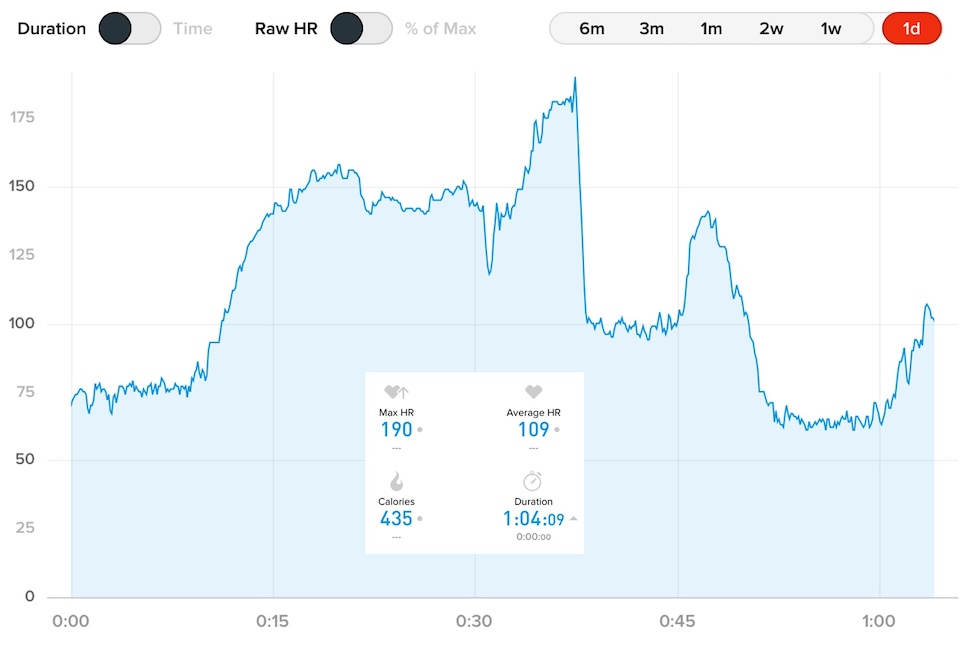
Some time ago, I asked people on social media what activity they thought corresponded to the heart rate graph versus the time shown above. As you can see from the graph, the activity lasted about an hour, with the number of heartbeats per minute shown on the y-axis.
Participant responses were creative and interesting, ranging from walking to running uphill. Most of the responses were related to cycling, and I also received one response that suggested rowing or diving.
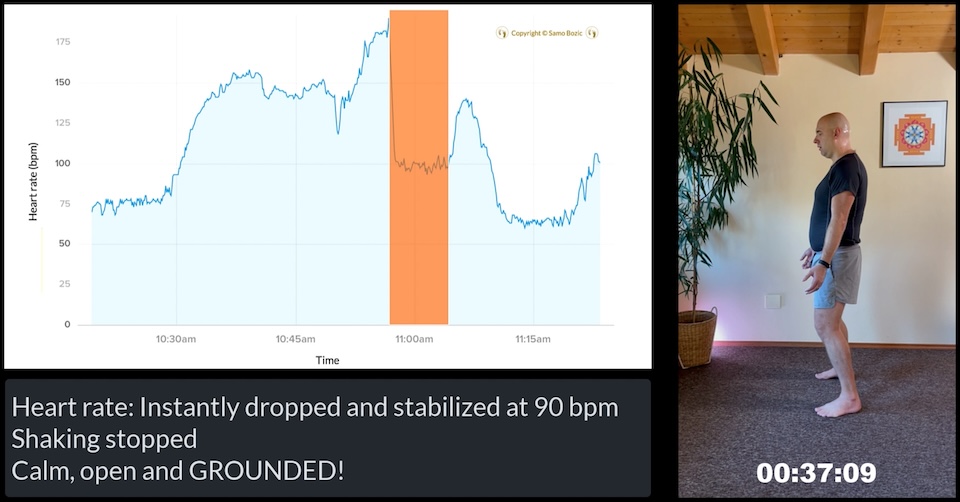
I have personal experience with all of the activities suggested by the readers and can say that all the responses were meaningful. From the graph, it appears to be an activity where the heart rate was steady for a while, then increased, reaching about 150 bpm for about 15 minutes, then rapidly increasing to 190 bpm at about 38 minutes and then dropping precipitously to about 90 bpm. As I gathered from the comments, this drop puzzled many who delved into the graph.
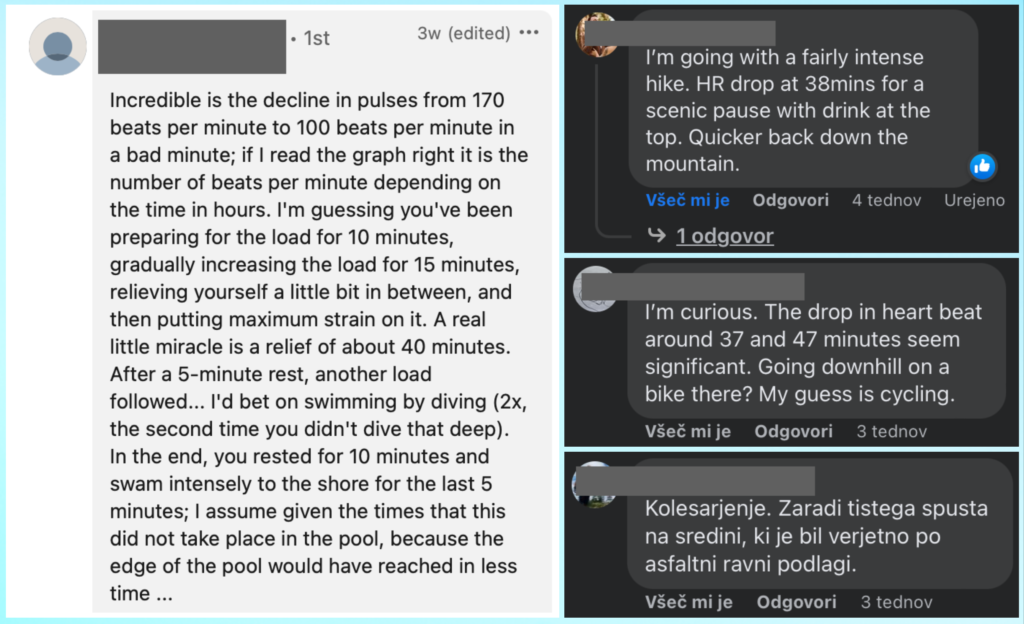
However, none of the readers’ suggestions mentioned my actual activity.
Surprisingly, the answer wasn’t a high-intensity workout or a thrilling adventure – it was the art of standing! Yes, you read that right. I recorded the measurement while standing for an hour with slightly bent knees – I was in a standing position.
I had expected that standing would not be among the answers people provided in response to the question. The fact is that standing is not usually perceived by people as physical “activity,” let alone that it is possible to raise your heart rate to 190 beats per minute or maintain a pulse of 150 beats per minute for a good 15 minutes just by “simply” standing.
Watching someone stand may seem relatively boring unless they explain what is happening inside them and their body during that time! One indicator of these processes can be heart rate.
On the day of this standing, I measured my heart rate throughout the day to compare it to various daily activities. Also, immediately after the activity, I noted what was happening to me physically, emotionally, and mentally during each standing phase. Then, I summarised all the observations and described them in a video that is part of the educational content of my Grounding Fundamentals online course. I thoroughly teach everything necessary to know in all other phases of standing through theoretical lessons and practical exercises in the course.
Connecting with the heart
When our heart rate changes, it’s a sign that something is changing in our body. When we aren’t doing intense cardio exercises or endurance training, changes in heart rate can be due to various physiological and/or emotional states in the body.
Along with blood pressure, measuring heart rate is one of the two relatively simple self-measurements that allow us to get in touch with our heart.
Thanks to advances in technology, heart rate measurement is now widely accessible. Various “fitness trackers” or slightly more advanced smartwatches allow each of us to track our heart rate 24/7. These devices are commonly used by recreational and professional athletes and allow them to adjust the intensity of their activities, rest periods, and recovery phases based on heart rate measurements.
These devices also often track sleep patterns, giving us valuable insight into our bodies and, consequently, ourselves. Since reading Matthew Walker’s book “Why We Sleep: Unlocking the Power of Sleep and Dreams,” I have fundamentally changed my perspective on sleep. One of the main reasons I initially acquired these trackers years ago was to understand what was happening to me at night and how good my sleep was.
As for connecting with the heart, there is a third way to get in touch with it, and that is through our feelings and emotions. In this case, our body serves as a measuring device connected to our consciousness. The effectiveness of this “measuring device” depends on our conscious connection with ourselves – with our body, its sensations, impulses, feelings, emotions, thoughts and behaviors.
When I bought these fitness trackers, I was also interested in whether they could make meaningful correlations between heart rate measurements and various emotional states. I was particularly interested in what happens during periods of relaxation, meditation, and grounding.
One device that particularly interested me was one that uses heart rate variability (HRV) for analysis. We know that the time between each heartbeat varies constantly in a “normal” resting heart rhythm. HeartMath Institute researchers have shown that heart rate variability is an important indicator of a person’s capacity for emotional self-regulation and an important autonomous function for health. They have described states of coherence. Someone who is in a state of physiological coherence shows:
- A high level of coherence in the heart rhythm
- Increased activity of the parasympathetic nervous system
- Increased coherence and synchronization of physiological systems
- Efficient and harmonious functioning of the immune system, cardiovascular system, nervous system, and endocrine system
Standing and grounding
Difficulties in regulating one’s emotions (inability to emotionally self-regulate) are often the reason people seek the help of a psychotherapist.
In my practice, I find that most emotional problems – difficulties controlling anger, problems with anxiety or panic attacks, as well as many relationship problems or difficulties connecting with other people – have some things in common from an energetic perspective:
- In a physical sense, people have blockages that manifest as various chronic tensions in the body. Where and how these tensions appear in the body depends on a person’s past and personal history.
- Most of us are “in our heads,” which ranges from overthinking and experiencing anxiety and panic to excessive self-judgment and judgment of others, brain fog, and so on.
- Most of us do not allow ourselves to experience and express certain emotions, which is nothing more than the basis for emotional blocks.
- In a spiritual sense, we are disconnected from who we really are and why we are here.
The problems people have are only symptoms – the cause is energetic in nature.
People are very creative when it comes to blocking the flow of energy in the body. Often we are not even aware of this blockage of our own energy flow, and sometimes we deny or hide it from ourselves. In this way, we remain in negative cycles and spirals of discomfort. The way we do this is fundamentally conditioned by our childhood development and specific past experiences that may have shaped us (traumatic events).
As children, we often did not allow ourselves to feel painful and uncomfortable emotions such as loss, fear, sadness or anger because this was not allowed by essential and less important people around us. By trying to regulate and hide painful and unpleasant feelings, we have unfortunately hidden and suppressed not only them, but also our vitality, aliveness, joy, creativity and sexuality. For this reason, as adults, we excessively direct energy flow upward in our bodies.
The way to natural wholeness is always to reverse the energy flow downward.
The way down is essentially grounding, which is not simply walking barefoot on the earth but a much more complex process. Grounding is much more than just some technique we perform. It consists of several aspects. One of the most important aspects is that it brings us more and more into more organic, natural and genuine connection with ourselves. This process also occurs in parallel with the activation of the heart and even deeper and lower parts of the body in the belly and, for women, in the womb.
Energy and “energetic”
Every time I write about energy in the body and directing energy downward, as both a physicist and a psychotherapist, I can well imagine how it all might sound – all that “energy”.
People often talk about “energies” but usually without a clear understanding of what they mean by it. There is usually no deeper understanding of “energy” and people use the word as it suits them and when it suits them.
In a physical sense, anyone who has made it past the eighth grade of elementary school in our educational system should know the definition of energy. When I write about energy in my articles, I base it on a few basic assumptions:
- I don’t go into the details of the definitions, I just say that energy can be transformed through work or heat.
- For any activity in the body and for all processes in the body to run smoothly, we need energy. That’s why we also need oxygen, food, water, sunlight etc.
- We cannot “see” energy in the body, but we can observe its effects. For example, we think, do squats, the heart beats etc.
All this is analogous to the statement that one second (s) is equal to “the duration of 9,192,631,770 oscillations of the radiation corresponding to the transition between two states of the caesium 133 atom.”
I did not make that up; it is the official definition of a second. However, if we don’t know anything about oscillations or transitions between energy states of atoms, the definition of a second doesn’t tell us much. We don’t even have a clue why there has to be such a definition!
At the same time, we don’t really need to understand these definitions for everyday use. For example, if someone tells us that we have 30 seconds to solve a puzzle, we all have a pretty good sense of approximately how long those 30 seconds are.
It is similar with grounding.
If we want to dive deeper into the experience and holistic understanding of grounding, which is something more than just taking off our shoes, breathing deeper, and maybe even hugging a tree… then one of the most important things in this process is activating the heart. For this, as for everything in the body, we need energy. However, since the heart is located deeper in the body than the brain, we need to direct the energy downward, as our natural energetic flow is almost automatically directed upward.
A deep interest in understanding the true role of our heart and seeking for ways to activate the heart in different ways has personally accompanied me since the moment I first saw the documentary “The Power of the Heart” It mentioned, among other things, an experiment whose description you can see in the video below:
Torej… če je to, kar pravijo, vsaj približno res, bi moralo vsakega izmed nas izjemno zanimati (ali pa skrbeti), kako oSo… if what they say is at least roughly true, each of us should be very interested (or concerned) about how we open or close our hearts. After all, what can we really lose by directing our energy to the heart instead of the brain? The answer, of course, is nothing; we can only gain a lot. It’s worth remembering this rule:
A closed and blocked body directs energy to the brain, while an open and flowing body directs it to the heart!
Similar to how the brain uses various energy entrances and exits in the body to gather information and consequently orient and interact with the environment, in a psychospiritual sense, the heart uses energy entrances and exits to weave, maintain and deepen relationships between us. Anyone who has ever TRULY FELT what it means to open their heart knows “the feeling” and is also not far from the awareness that:
- Sometimes just a tenth of a second of eye contact is enough to awaken or forge an incredibly deep connection between two hearts.
- The hands are an extension of the heart.
- Contact with the abdomen “melts” the heart.
- Free sexuality and emotional intimacy go hand in hand with an open heart and in-flow genitals.
- We can also “fire” the heart through the feet.
- Breathing has a direct influence on the heart and heart rate.
If all this sounds like theory and philosophy to you, there’s a good chance you’re trying to understand it with your mind. But matters of the heart cannot be understood in this way. We can never reach the heart with the mind; we can only observe what happens with the heart. Feeling with the heart is something entirely different from thinking and “understanding” with the mind. The path to oneself often involves a transition from an intellectual understanding of “self and everything” to a deeper emotional experience of oneself and others, and a deeper and more subtle sensory connection with oneself, others, the world, and one’s intuition.
In my conceptual world, standing with legs slightly bent (“standing” for short) and observing inner sensations is one of the most optimal practices I have encountered over the past 30 years of exploring the body, first through sports and martial arts, and then through body psychotherapy. For me, standing is an extraordinary practice that can be used consciously to open the body and the heart, and a way to withdraw energy from the brain for a moment and direct it to other psychospiritually important body centers – heart and belly.
Standing and learning to observe the inner sensations is also the first homework that most of my clients receive at the beginning of our work. However, this doesn’t mean standing for an hour, as in the example above, but only for a few seconds to a few minutes at first.
Painful calves
Once we become adept at inner observation through standing, experience shows that we need only a short time to pause and calm down to ground ourselves.
This can also be quickly seen in the heart rate curve while standing. Within my one hour of standing, we can observe intervals in which the heart rate increased, decreased and remained constant.
These changes in heart rate were not due to changes in mechanical energy since I was standing still the entire time. Instead, they were the result of changes in the body. Since I wasn’t thinking hard, these changes were not due to mental effort either. They were the result of changes in feeling.
When I connected these intervals to internal sensations and feelings, I found that I felt grounded during the intervals with a relatively constant heart rate. I had a sense of openness and calmness. Everything seemed to pause during these intervals, and I felt present in that moment.
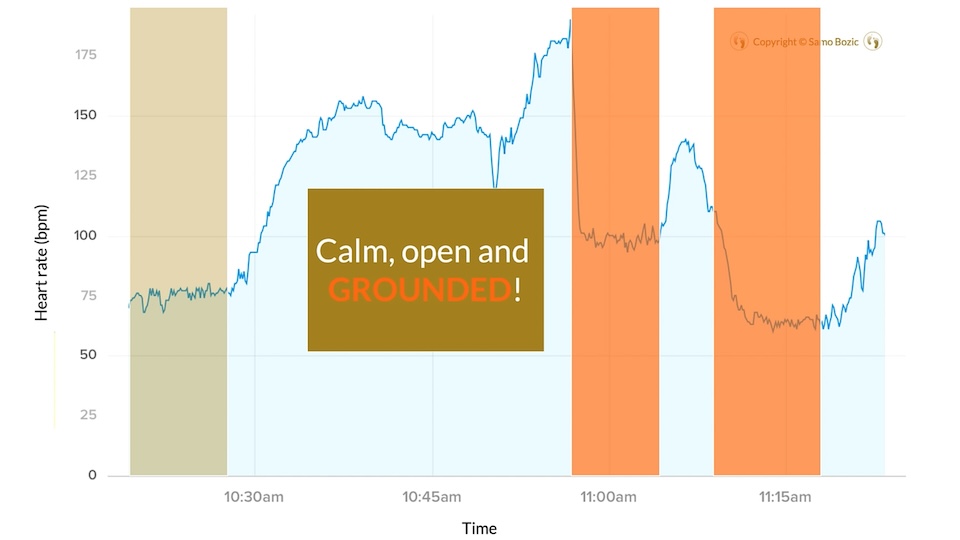
In this particular case, I felt a sense of grounding three times. The first time was right at the beginning and lasted about 10 minutes.
It’s important to know that these intervals vary from person to person and are highly individual. However, for most of us, it’s typical to be able to calm and ground ourselves by simply standing, bending our knees slightly, taking a breath, and looking inward for a moment.
The initial feeling of grounding is usually less intense than the intensity of the grounding feelings that occur later as we continue to stand. However, more work is required to achieve a more intense feeling of grounding. To do this, we need to understand some basic principles, mainly how to deal with uncomfortable sensations that we inevitably feel when standing for long periods with our knees slightly bent, and then consciously process them.
Remember that impossible physical definition of a second from a few minutes ago? Understanding these grounding principles and working with uncomfortable sensations is analogous to understanding oscillations or understanding transitions between energy states of atoms in defining a second!
In other words?
To be calm, open and grounded, we don’t have to be attractive, have a perfect or right kind of body, or have the right weight. Nor do we have to be super-intelligent or special or important in any other way. But we do need to know how to consciously “handle with” uncomfortable feelings and sensations.
In my therapy room, I often experience that the unpleasant sensations I mentioned earlier are a common reason why people don’t stand in an optimal position, for example. So, as soon as we go into an open and energetically neutral position, the body begins to deal with extra tension (standing is emotionally neutral and energetically open, which means that it doesn’t anticipate certain emotional states and allows us to experience both pleasant and unpleasant sensations while standing). In this case, unlike most sports, the body works in the opposite direction. Sports are often about “building” muscle through exercise, while the energetic opening of the body and grounding is all about relaxation and releasing muscle tension.
I remember my uncomfortable sensations very well when I started consciously practicing standing many years ago. I remember how, after a few minutes, I got this intense pain in my lower right leg. This pain in the calf was so intense that I simply couldn’t continue standing and I had to stop.
I was frustrated. In my mind, I was competing with a Tai Chi master I had read about who could stand for hours. It took me quite a while to get past the pain phase and begin to increase the standing time. At the same time, I identified mistakes and developed essential guidelines that I teach in my course to help others not repeat similar mistakes I made in the beginning.ke, ki jih učim v svojem programu in ki pomagajo ljudem, da ne ponavljajo podobnih napak kot sem jih delal na začetku.
Aside from giving our bodies permission to do what they need to do while standing, our intention and focus on observing the inner world and our emotional reality are also important.
Back to the heart
An essential element of grounding is the activation of the heart – not by building a muscle armor around it (hello, fitness!), but by working with the release of muscle tension in the body, with our openness and vulnerability.
To me, the heart is an organ that exists in different energy states and is connected to its physical, emotional and spiritual functions. One of the indicators of a change in the energetic state of the heart is the heart rate. When the heart rate increases, it simply means that the heart had to make more beats per minute, which requires more energy.
It’s more than evident that while standing, I can direct energy to the heart, activate it and change its energetic state.
As I mentioned earlier, grounding has several dimensions. In my Grounding Fundamentals course, I teach about the five dimensions of grounding. Everyone can work on the first four on their own.
The relational dimension with other people is the fifth dimension of grounding, which can only be worked on in contact with other people. In these cases, appropriate psychotherapy can be of great help. Typically, people who have problems with the relational dimension of grounding also have problems with the other four dimensions, because each dimension has a fundamental connection to relationships. Man and woman are relational beings, and this is evident on all levels of our existence!
And in relationships… THE HEART is KING!
There is also a deep knowing in the heart. But to get answers from the heart, it must literally be stripped of its muscle armor, be understood, and have time to “come into its own truth”.
At the same time, we must know that the heart will not give us answers in the language of the head, but through feelings, truth and intuition.
To what extent we really listen to our heart and follow its instructions with our actions is another question…
That is why it is said that the longest journey a person has to make in life is the journey from the head to the heart.
With my wife Tina, she is also a psychotherapist and psychologist, we go even further. We both agree that the longest journey we have to make is the journey from the head through the heart to the depths of the belly and then back again and out…
Are you with us on this journey?

Useful!
The longest journey a person has to make in life is the journey from the head through the heart to the depths of the belly because the head doesn’t know, while the heart knows and the belly carries deep feelings of self. We can only connect with the heart and the belly through introspection and opening up to deeper body sensations. One of the most down-to-earth methods of directing energy flow downward, to the heart and into the body, is certainly grounding.
* Samo Božič is a certified body psychotherapist in private practice in Slovenia. He graduated on the Netherlands institute for Core Energetics (NICE) and he is a full member of the European Association for Body Psychotherapy (EABP). He is deeply invested in developing therapy work in individual and group settings, connecting issues of manhood, fatherhood, sports, nature, grounding and grounded spirituality. He is married to Tina, who is also a psychotherapist, and he is a proud father of two inspired teenage girls who enrich his life and fill his heart.